

“Cape luong maestra pazza”, “Finì Agóst gió ul sù le fosc”, “Ce cu voli a butti ghina e a mugghieri ‘briaca”
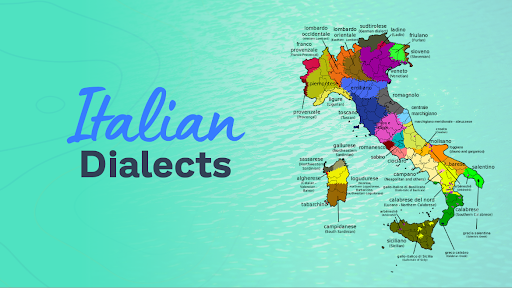
What you just read are sentences in different Italia dialects! As you know, Italy is divided in 20 regions and each one of them has a dialect of its own.
Dialects differ greatly from the area they are spoken, and sometimes different cities of the same region have different dialects, making Italy a country with a big variety of (unofficial) spoken languages.
We can divide Italy in 2 parts, regarding dialects: Northern and Central-Southern. What are the differences between these two areas? In what the Sicilian dialect is different from the one spoken in Naples? Do people who live in Milan understand someone from Bologna?
Let’s try to answer to all of these questions and more!

History of dialects
Since the first expansion of the Roman dominion on the peninsula, there has always been a coexistence of a cultured language, classic Latin, and various local variations, called vulgar or vernacular, not codified nor written, spoken in the various parts of the country.
Each area, even the tiniest, has developed over time a specific way of speaking. Since communications between close areas were somehow frequent, there’s a dialectal continuum between neighboring dialects, while the differences gradually increase if we compare two distant dialects.
It follows that Italian dialects are not variants of Italian. They were born before modern Italian, and therefore they cannot derive from it. They derive however from dialects of vulgar Latin, i.e. the Latin spoken by the people.
The only variety of Italian language is in the Tuscan dialect, because, as you may know, standard Italian mostly derives from Tuscan language, with roots in the works of great writers of 1200 like Dante, Boccaccio and Petrarca.
Northern dialects
The Northern dialects are in turn divided into two main groups: The Gallo-ltalic group and Venetic group.
The first encompasses the regions of Liguria, Piemonte, Lombardia and Emilia-Romagna as well as parts of Trentino Alto Adige. It is a grouping named after the Gauls who once inhabited this part of Italy and who left traces of their Celtic speech in the modern dialects.
The other is the Venetic group whose borders loosely follow the region of Veneto.
Central – Southern dialects
The Central-Meridional dialects are of four distinct groups.
The specific central grouping occupies an area roughly that of the region of Tuscany. To the immediate south are the Latin-Umbrian-Marchegian dialects which occupy the northern half of Latium (including Rome), most of Umbria and some of the Le Marche. These two are also sometimes grouped together as the Central dialects.
Directly below them are the Southern dialects divided into two major types. The Intermediate occupies the bottom half of the peninsula and includes the regions of southern Lazio, Abruzzo, Molise, Campania, Basilicata and parts of Apulia.
The tips of Calabria and Apulia, together with Sicily, delineate the zone of the extreme Meridional dialects. Finally, Sardinia has a category of its own.
What’s more?
The use of dialects in Italy represents a unique situation compared to the rest of Europe. Even today in many different parts of Italy dialects are used as an informal way of communicating in different social settings and within families.
Contrary to popular belief, in certain Italian regions dialects are widely used, and not only within the older generations. Even though the use of standard Italian prevails in the younger generations, many young people can express themselves in their own dialect, or at least understand it, in informal social situations.
It is also worth remembering that dialects, as well as accents, can change a lot even within the same region. Of course, major cities in Italy also have wonderful dialects of their own. So, in Milan, Turin, Rome, Florence you will hear people talking in Milanese, Torinese, Romanesco, Napoletano and Fiorentino. And all of them have different characteristics.


